How we rate additives
Every additive on the label gets one of four levels, coloured like the paw in our logo. Each level takes points off the 15-point “Additives & safety” part of the score. It’s about health only, never price.
ⓘOur own assessment. These ratings are Pet Food Monitor’s opinion of the cited evidence, using our published method. They aren’t a regulator’s decision, and an additive’s rating isn’t a finding that any food containing it is unsafe.
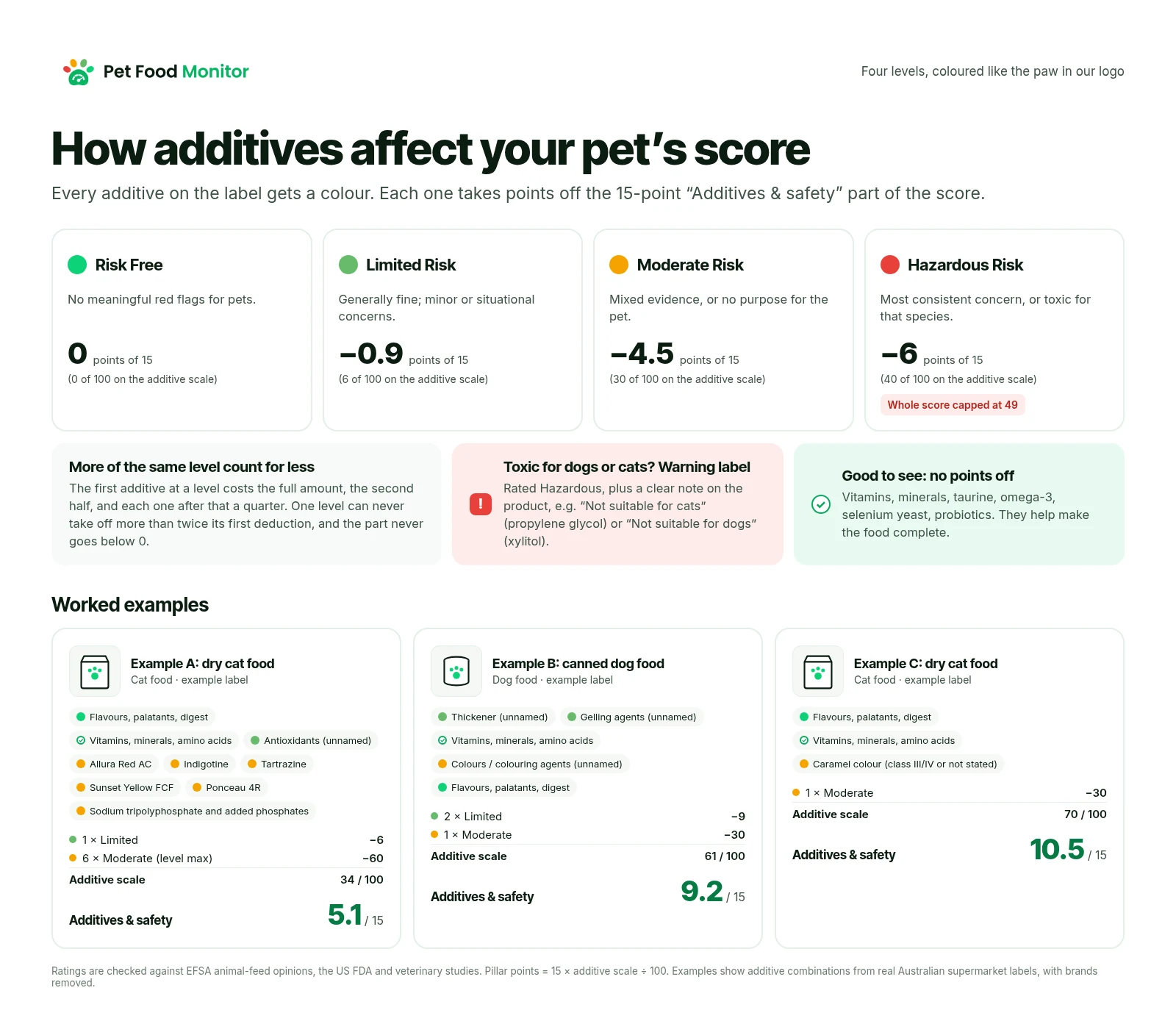
Four levels, four colours
We work out an additive scale from 100. Each additive takes points off it, and the result is scaled to the 15-point pillar (pillar points = 15 × additive scale ÷ 100).
−0 of the 15-point Additives & safety pillar for the first one.
No meaningful red flags for pets.
−0.9 of the 15-point Additives & safety pillar for the first one.
Generally fine; minor or situational concerns.
−4.5 of the 15-point Additives & safety pillar for the first one.
Mixed evidence, or no purpose for the pet.
−6 of the 15-point Additives & safety pillar for the first one.
The most consistent concern, or toxic for that species. Caps the whole score at 49.
More of the same level counts for less
Foods often list several additives from the same level, such as four or five synthetic colours. To keep one problem from being counted five times, deductions stack like this:
- The first additive at a level costs the full amount.
- The second costs half.
- Each one after that costs a quarter.
- One level can never take off more than twice its first deduction, and the additive scale never goes below 0.
Example: two Moderate Risk colours cost 30 + 15 = 45 points. Six of them reach the level maximum of 60.
Separately, any Hazardous Risk additive caps the whole food score at 49, however good the rest of the food is.
Points off the 100-point additive scale.
Dogs and cats are rated separately
Cats and dogs process some substances very differently, so every additive has a dog rating and a cat rating. Some examples from our list:
- BHA: Moderate Risk for dogs, Hazardous Risk for cats, because EFSA couldn’t establish a safe level for cats.1
- Propylene glycol: Hazardous Risk for cats, and US rules prohibit it in cat food.2
- Xylitol: Hazardous Risk for dogs, where it can cause a dangerous drop in blood sugar.3
- Rosemary extract: Risk Free for dogs, Limited Risk for cats, because the cat safe level is lower.4
Species warnings
An additive that is toxic for a species is rated Hazardous Risk and gets a clear warning on the product, such as Not suitable for cats (propylene glycol) or Not suitable for dogs (xylitol).
Nutrients: no points off
Some things on an ingredient list help make a food complete and balanced. We rate them Risk Free and never take points off for them:
- vitamins, minerals and amino acids
- taurine (essential for cats)
- omega-3 fatty acids (EPA and DHA)
- selenium yeast
- probiotics and prebiotics
Unnamed additives
Some labels list only a type, such as “antioxidants”, “colours” or “gelling agents”. Because we can’t tell which additive it is, we rate the type cautiously until the maker names it.
How additives affect your pet’s score
The worked examples use additive combinations taken from real Australian supermarket labels, with brands removed. They show how the method works in practice.
SOURCES FOR THE EXAMPLES
- EFSA FEEDAP Panel (2019). Safety of butylated hydroxy anisole (BHA) for all animal species. pmc.ncbi.nlm.nih.gov
- US Code of Federal Regulations, 21 CFR 589.1001: Propylene glycol in or on cat food (part 589, substances prohibited from use in animal food or feed). www.ecfr.gov
- US FDA. Paws off xylitol; it’s dangerous for dogs. www.fda.gov
- EFSA FEEDAP Panel (2022). Safety and efficacy of two solvent extracts of rosemary for cats and dogs. pmc.ncbi.nlm.nih.gov
Be first to scan when we launch.
One email at launch, plus new research. Unsubscribe any time.
Waitlist opening soon. This form is a preview and doesn’t collect or store anything yet.