
Key takeaways
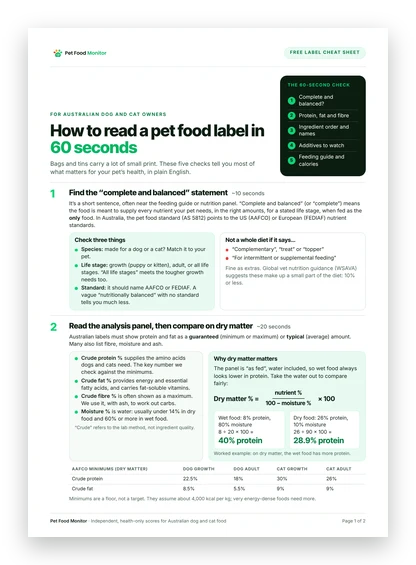
- “Complete and balanced” means the food is meant to supply every nutrient a dog or cat needs, in the right amounts, for a stated life stage, when fed as the only food.
- In Australia, AS 5812 says a complete pet food should meet the nutrient requirements in either the AAFCO Official Publication or the FEDIAF Nutritional Guidelines.
- Check three things: the statement itself, the life stage, and which standard (AAFCO or FEDIAF) it refers to.
- “Complementary”, “treat” or “for intermittent or supplemental feeding” means the food isn’t designed to be the whole diet.
The short answer
A food labelled “complete and balanced” (or simply “complete”) is meant to provide all the nutrients your dog or cat needs, in the right proportions, for a particular stage of life, when it is fed as their only food. It is not a claim about quality, taste or ingredients. It is a claim about nutritional adequacy.
The Australian Standard for pet food defines a complete pet food as one that “is nutritionally complete and meets the minimum recommended nutritive requirements for cats or dogs”, as set out in a recognised international nutrition publication, and notes that such a food “may also commonly be described as ‘complete and balanced’”.1
Who sets the rules in Australia?
The main reference is AS 5812:2017, Manufacturing and marketing of pet food, published by Standards Australia. First released in 2011 and revised in 2017, it covers how pet food is made, from sourcing ingredients through processing and packing to labelling.1
For nutrition, AS 5812 doesn’t write its own nutrient tables. It points to an “international nutritional publication”, which it defines as either the AAFCO Official Publication or the FEDIAF Nutritional Guidelines, each used in its entirety. The 2017 edition added FEDIAF as an alternative to AAFCO.1 “In its entirety” matters: a manufacturer is meant to pick one framework and follow it, not mix and match the most convenient numbers from each.
AS 5812 is an industry standard rather than a law written specifically for pet food. The Pet Food Industry Association of Australia (PFIAA) uses it as the reference for its members’ labelling and nutritional adequacy statements.5 Not every brand on the shelf is a PFIAA member, which is one more reason to read the label yourself.
AAFCO and FEDIAF, in plain English
AAFCO (United States)
The Association of American Feed Control Officials publishes the Dog and Cat Food Nutrient Profiles in its Official Publication.2 For each species there are two profiles: one for growth and reproduction (growing, pregnant and nursing animals) and one for adult maintenance. Every nutrient listed has a minimum level, and some also have a maximum. The levels are expressed on a dry-matter (moisture-free) basis.4
Under AAFCO, a manufacturer can back a “complete and balanced” claim in one of two ways: by formulating the food to meet the relevant nutrient profile, or by passing an animal feeding trial run to AAFCO procedures.4
FEDIAF (Europe)
FEDIAF, the European pet food industry federation, publishes the Nutritional Guidelines for Complete and Complementary Pet Food for Cats and Dogs, which are reviewed and updated as new research is published.3 As the title suggests, the guidelines draw a clear line between a complete food, which can be fed on its own, and a complementary food, which needs to be fed alongside other foods.
Both frameworks build on the scientific literature, including the US National Research Council’s Nutrient Requirements of Dogs and Cats (2006).
Reading the statement on the label
Look for a short sentence, often near the feeding guide or the nutrition information. The wording varies, but it usually looks something like one of these (example wording, not taken from a particular product):
- Formulated to a standard: “Formulated to meet the nutritional levels established by the AAFCO Dog Food Nutrient Profiles for adult maintenance.”
- Feeding trial: “Animal feeding tests using AAFCO procedures substantiate that this food provides complete and balanced nutrition for growth and reproduction.”
- FEDIAF: “Complete pet food for adult cats, formulated in line with the FEDIAF Nutritional Guidelines.”
- Not a whole diet: “Complementary pet food. Feed with a complete diet.”
“All life stages” means the food meets the more demanding growth and reproduction requirements, so it can be fed to puppies or kittens as well as adults. AAFCO also expects foods for growth to say whether they are suitable for puppies that will grow into large dogs, defined as 70 lb (about 32 kg) or more as an adult.2
A 30-second label check
- Find the statement. Look for “complete and balanced”, “complete pet food”, “complementary” or “treat”.
- Check the species and life stage. Dog or cat; growth (puppy or kitten), adult, or all life stages. Match it to your pet.
- Check the standard. It should name AAFCO or FEDIAF. A vague claim like “nutritionally balanced” with no standard tells you much less.
- Check how it was substantiated. Formulated to meet a profile, or tested in a feeding trial.
- If it’s complementary or a treat, it isn’t designed to be the whole diet. That’s fine for toppers and treats, but not as the main meal.
What the claim doesn’t tell you
“Complete and balanced” is a minimum bar, not a ranking. Two foods can both meet the same profile and still differ a lot in ingredients, digestibility, energy density and price. The claim also doesn’t mean a food suits every individual animal. Pets with health conditions, allergies or special needs may need a different diet, and veterinary diets should be fed on your vet’s advice.
The WSAVA Global Nutrition Committee suggests owners also look at who formulates the food and what quality control the manufacturer uses.6 We’ll cover those questions in future guides.
How this affects our score
Nutritional adequacy is the biggest pillar in our scoring method. In our method, a food sold as a main meal without a clear complete-and-balanced statement for its species and life stage is capped at 24 out of 100, whatever else is in it. The weightings are our own assessment of the published standards and evidence, and every rule is published. See how we score.
This guide is general information, not veterinary advice. If you’re unsure what to feed your pet, talk to your vet.
SOURCES
- Standards Australia. AS 5812:2017 Manufacturing and marketing of pet food (preview: scope, definitions 1.4.5 and 1.4.7, and changes from the 2011 edition). store.standards.org.au
- Association of American Feed Control Officials (AAFCO). Official Publication: Dog and Cat Food Nutrient Profiles and model pet food regulations. www.aafco.org
- FEDIAF. Nutritional Guidelines for Complete and Complementary Pet Food for Cats and Dogs. europeanpetfood.org
- US Food and Drug Administration. “Complete and Balanced” Pet Food. www.fda.gov
- Pet Food Industry Association of Australia (PFIAA). Understanding pet food labels. pfiaa.com.au
- WSAVA Global Nutrition Committee. Guidelines on selecting pet foods. wsava.org